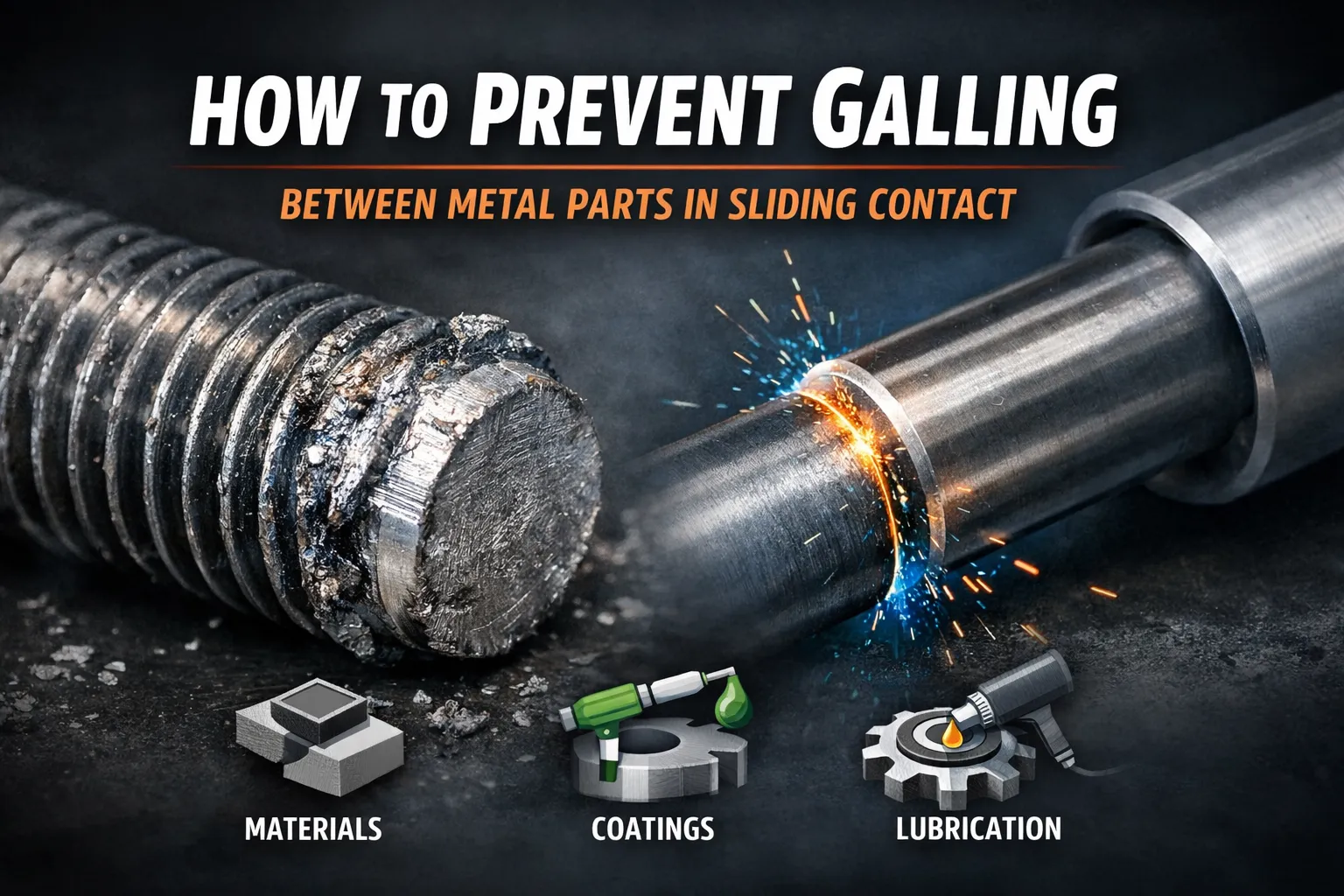
If you’ve ever seen two metal parts seize, tear, or suddenly feel “gritty” after repeated motion, you’ve likely encountered galling.
Galling is one of those failure modes that looks mysterious at first and obvious in hindsight. Two parts were supposed to slide. Instead, they slowly welded themselves together.
At Ziqual, we see galling most often in early prototypes, low-volume production runs, and consumer products where aluminum and stainless steel are common choices. The good news: galling is predictable, and with the right design decisions, entirely preventable.
This article walks through how to minimize galling using practical, manufacturing-ready strategies.
What is galling, really?
Galling is a form of adhesive wear. Under load, microscopic high points on two metal surfaces cold-weld together. As sliding continues, those welded junctions tear apart, pulling material from one surface to the other.
Once this starts, it accelerates:
- Surface damage increases friction
- Friction increases heat
- Heat increases adhesion
Eventually, the motion degrades or stops entirely.
Galling is especially common when:
- The two metals are similar
- Loads are high
- Motion is slow or oscillatory
- Lubrication is marginal or absent
1. Use dissimilar metals whenever possible
This is the single most effective way to prevent galling.
High-risk pairings
- Aluminum ↔ aluminum
- Stainless steel ↔ stainless steel
Much safer pairings
- Aluminum ↔ steel
- Stainless steel ↔ bronze
- Steel ↔ brass
Dissimilar metals are less likely to cold-weld because their surface chemistries and hardness levels don’t match. If your design allows a material change, start here.
2. Create a hardness difference
Galling loves symmetry. When two surfaces have similar hardness, they deform and weld together at the same rate.
A good rule of thumb:
Aim for a meaningful hardness difference between the two surfaces.
Common approaches:
- Harden one surface (heat treatment, anodizing, nitriding)
- Make one component sacrificial and easy to replace
- Use a bushing or insert instead of direct metal-to-metal contact
For aluminum parts, hard anodizing is often the most practical solution.
3. Use surface coatings to break metal-to-metal contact
When materials can’t change, coatings do the heavy lifting.
Some of the most effective anti-galling options:
- Hard anodize (Type III) on aluminum
- DLC (diamond-like carbon) for low friction and high wear resistance
- PVD coatings like TiN or CrN
- Electroless nickel with PTFE
- Dry film lubricants (PTFE, MoS₂, WS₂)
The goal is simple: ensure that coating-to-coating or coating-to-metal contact happens instead of bare metal contact.
For consumer products, hard anodize with a PTFE seal is often the best balance of durability, appearance, and cost.
4. Use the right kind of lubrication
Not all lubricants prevent galling. Light oils often squeeze out under load and provide little protection once motion slows.
What works best:
- PTFE-based greases (clean, consumer-safe)
- Molybdenum disulfide (MoS₂) greases for higher loads
- Dry film lubricants when contamination or migration is a concern
- Anti-seize compounds (used carefully in consumer-facing designs)
Lubrication should be viewed as a boundary layer, not just friction reduction.
5. Don’t over-polish your surfaces
This surprises many engineers.
Extremely smooth surfaces increase the real area of contact, which actually makes galling more likely. On the other hand, very rough surfaces create stress risers.
A good target surface finish:
- Ra ≈ 0.4–0.8 µm (16–32 µin)
This provides enough texture to retain lubricant without increasing wear.
One important rule:
Never lap or mirror-polish two mating surfaces made of the same metal.
6. Reduce contact stress in the design
Galling is pressure-dependent. Lower contact stress means lower risk.
Design strategies include:
- Increasing contact area
- Avoiding sharp edges or line contacts
- Using bushings or liners
- Adding slight compliance instead of rigid constraints
Small geometry changes often do more than exotic materials.
7. Pay attention to motion and use case
Galling is most severe under:
- Slow sliding
- High load
- Start–stop motion
- Small oscillations
If your product experiences micro-movements rather than continuous rotation, galling risk goes up. In those cases, coatings and dry-film lubricants become even more important.
Practical material combinations we recommend
From real-world manufacturing experience, these combinations work well:
Best
- Hard-anodized aluminum ↔ steel pin
- Hard-anodized aluminum ↔ PTFE-lubed aluminum
- Aluminum ↔ bronze bushing
Acceptable
- Aluminum ↔ aluminum with dry-film PTFE or MoS₂
Avoid
- Bare aluminum ↔ bare aluminum under load
- Stainless ↔ stainless without coating or lubrication
The takeaway
Galling isn’t a mystery and it isn’t bad luck.
It happens when bare metals touch under load and motion. Prevent it by:
- Changing materials
- Introducing hardness differences
- Using coatings
- Applying the right lubrication
- Designing for lower contact stress
At Ziqual, we help customers catch galling issues before parts go into production—when fixes are still simple and inexpensive.
If you’re unsure whether your design is at risk, it’s worth addressing early. Galling rarely announces itself politely.